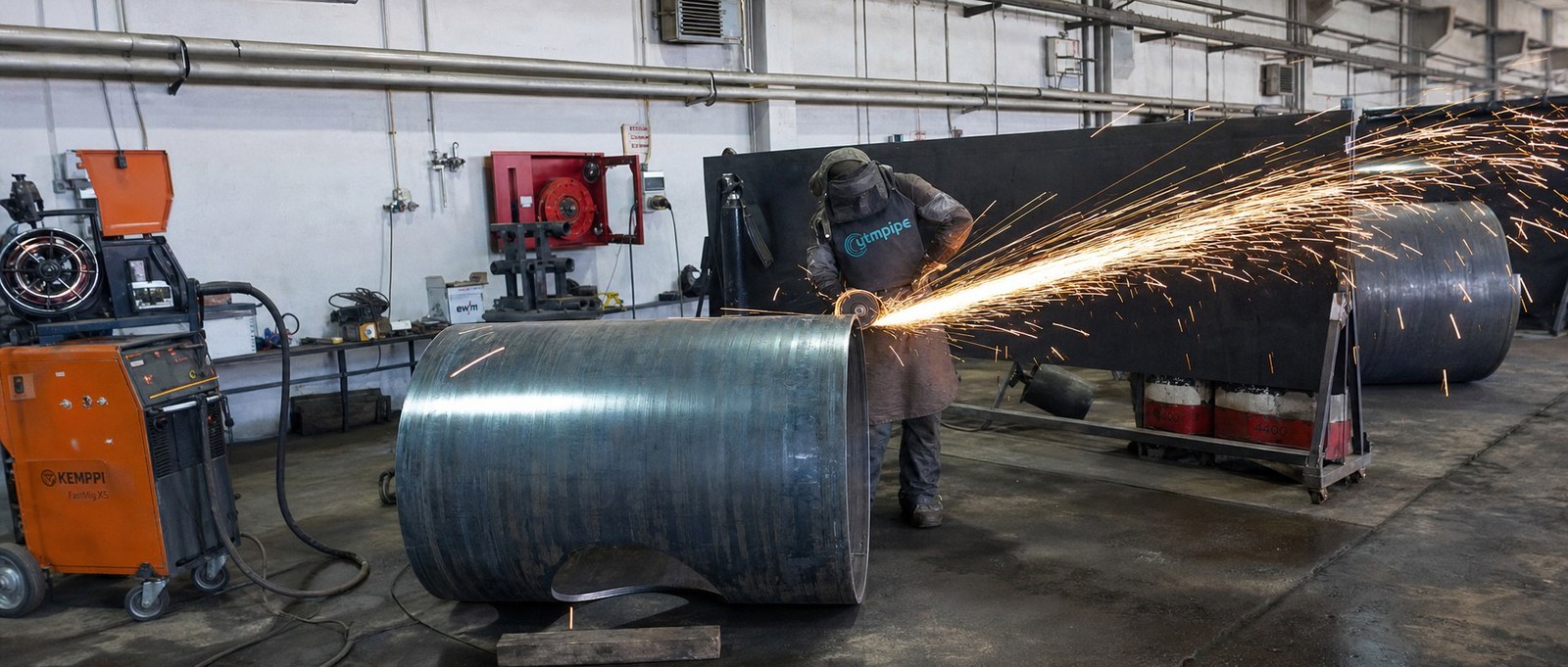
Cutting to the drawing
Fabrication begins at the cutting table, not the welding bay. Every length of pipe and every plate is taken from the isometric drawing and cut to its exact dimension in the workshop, under controlled conditions. That removes the single biggest source of variation in piping work: the manual field cut.
Cutting in-house also means every piece is traceable. Each cut length is checked against the drawing before it moves to the next station, so an error is caught at the saw — where it costs minutes — rather than at fit-up, where it costs days.
Rolling & forming
For large diameters and special sections, pipe starts life as flat plate. The plate is rolled to the required diameter and seam-welded, producing a cylinder to the specified wall thickness and material grade.
Rolling our own sections gives us control over dimensions that off-the-shelf pipe cannot always offer — non-standard diameters, heavy walls, or short one-off lengths for a specific spool. The seam is welded and dressed as part of the same controlled process, so a rolled section arrives at fit-up to the same standard as mill pipe.
Beveling & grinding
A weld is only as good as the joint geometry beneath it. Every pipe end is machine-bevelled to the angle the welding procedure calls for, then ground and dressed so the root face and land are consistent around the full circumference.
Consistent preparation means the welder is never compensating for a bad edge. The gap is uniform, the root fuses cleanly, and the finished joint has the geometry the design assumed. It is unglamorous work — and it is where weld quality is actually decided.
Cleaning & check
Before any joint is welded, the prepared surfaces are cleaned back to bright metal. Scale, oil, paint and moisture are all contamination that ends up inside the weld if it is not removed — the kind of defect that only shows itself years later, in service.
A final check closes the loop: dimensions against the isometric, bevel angle and root face against the weld procedure, surface condition by eye. Only then does the piece move on to fit-up. Preparation like this is invisible in the finished spool, which is exactly the point — nothing about the weld should be left to chance.
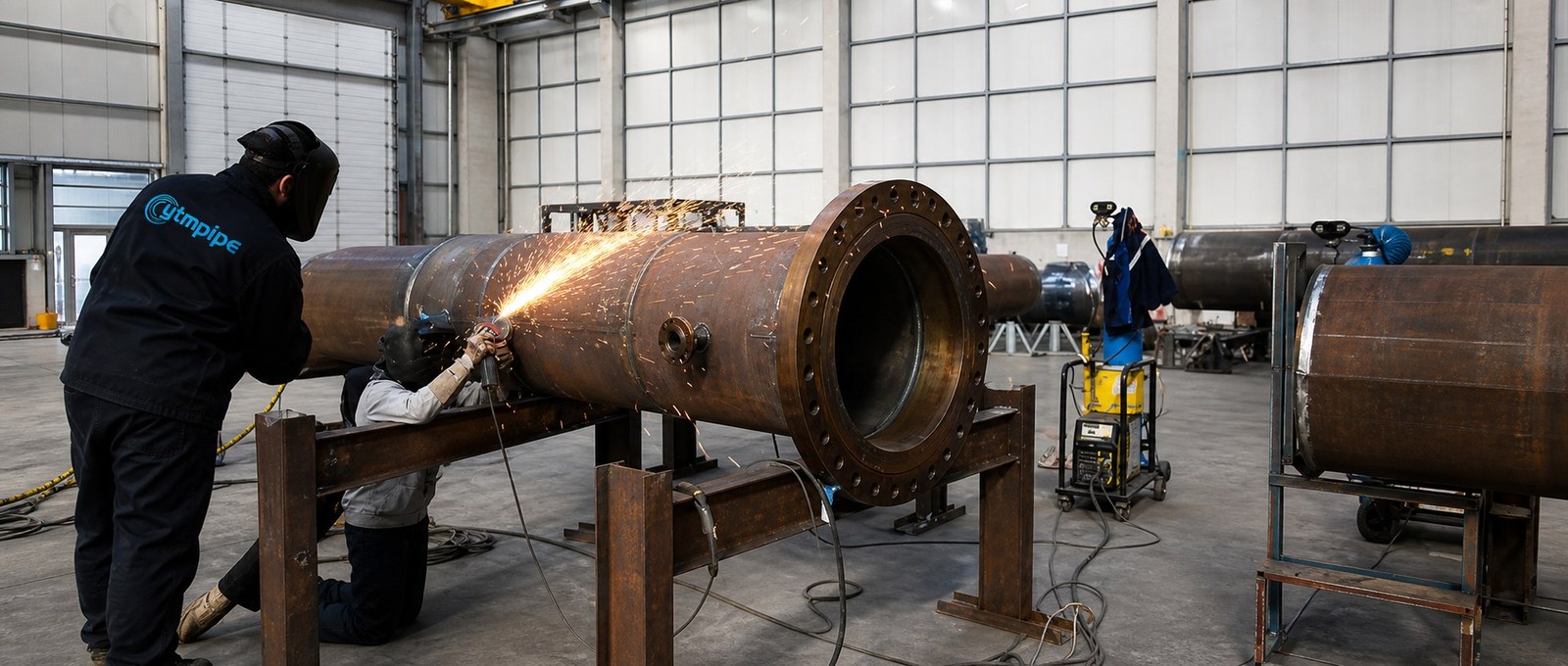
Pipe Spool Fabrication: Fit-Up, Welding & Inspection
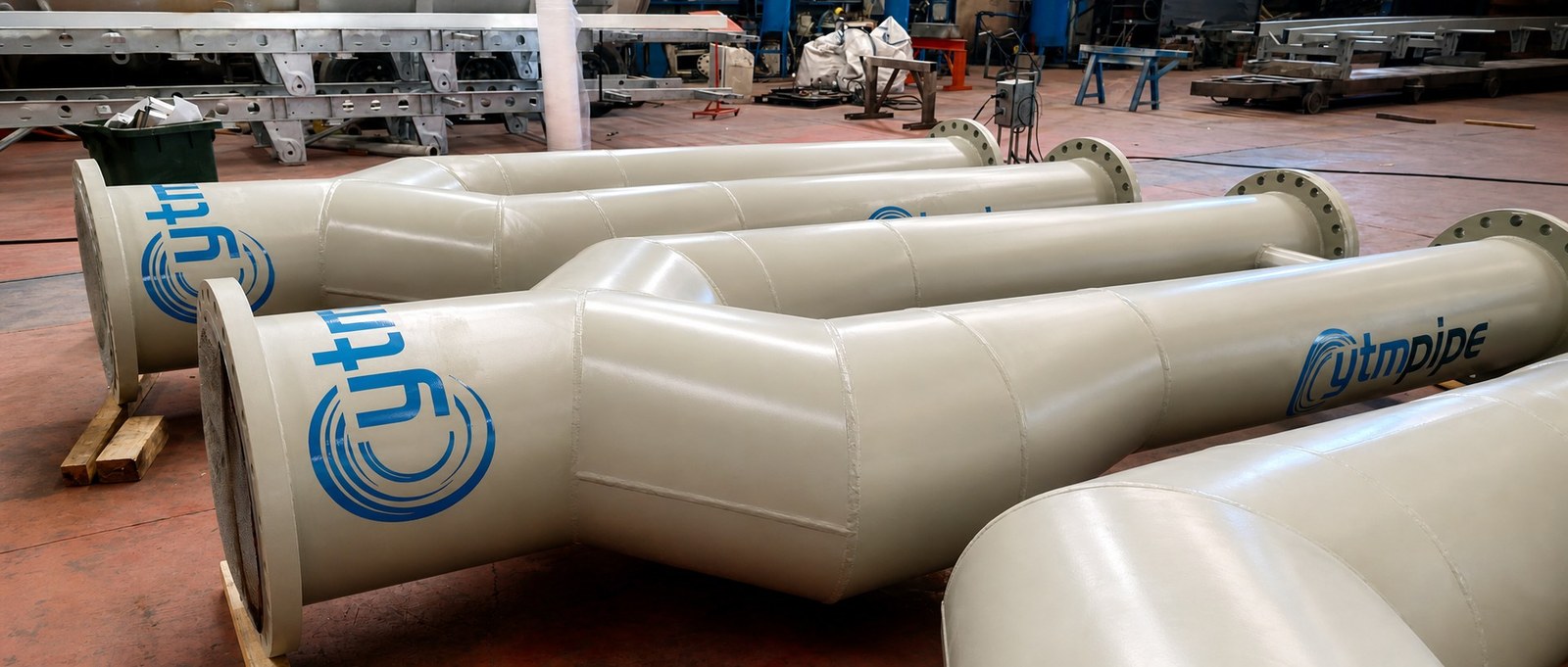
Coating & Finishing for Long Service Life
Have a project in mind?
Our team can advise on the right products and fabrication for your specification.
Request a QuoteHave a project in mind?
Our team can advise on the right products and fabrication for your specification.
Request a Quote